Intelligent Document Processing That Actually Works in Production
By Quantiva Team

The 95% Demo, the 60% Reality
Every intelligent document processing vendor will show you a demo where their system extracts data from a PDF at 95% accuracy. Clean document, standard layout, perfect scan. The demo is real. The problem is that your documents don't look like the demo.
We've been building document AI systems for over a decade across financial services, media, healthcare, and insurance. The pattern is always the same: a client sees a vendor demo, buys the platform, connects it to their actual documents, and watches accuracy drop to 60%. Sometimes lower. The vendor blames the documents, the client blames the vendor, and the project stalls.
The gap between demo and production is structural. Real document collections contain layout variation, degraded scans, and formatting inconsistencies that no single extraction model handles well. Picking a better vendor doesn't fix it.
Why No Single Tool Solves It
Document processing has several distinct subproblems, and each one has a technology that handles it well in isolation.
Template-based extraction works perfectly when every document follows the same layout. The moment layouts vary, it breaks silently.
OCR services handle text extraction well, but struggle with complex tables, especially the line-item data that actually matters for financial analysis.
AI models that understand page layout can handle variation, but they process pages independently. A table that continues on the next page is invisible to them.
Large language models are the best at understanding what a document means. They can find a fee table even when the header text varies. But they sometimes return wrong numbers that look right. On financial documents where a misplaced decimal changes meaning by orders of magnitude, "usually right" is not good enough.
No single approach covers the full problem, but they complement each other well if you wire them together correctly.
Building Blocks, Not Monoliths
Over a decade of deployments, we've stopped building document processing systems from scratch. Instead, we've distilled the work into a set of reusable building blocks that compose into pipelines tailored to specific document types and industries.
The specific labels, validation rules, and confidence thresholds change per domain. The architecture stays the same.
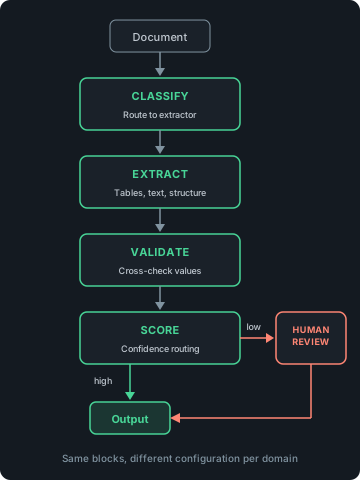
Classification sorts incoming documents and routes each one to the right extraction approach. A financial table needs different handling than narrative text or a structured form. Getting the routing right is what makes everything downstream work.
The hardest subproblem is table extraction. It reconstructs the structured data that humans see in a table but that doesn't actually exist in the underlying file. Merged cells, spanning headers, tables that continue across pages. Every domain that deals with tabular data needs this solved, which is most of them.
Cross-validation checks AI-extracted values against the raw text in the original document. When the AI returns a number, we verify it matches what's actually on the page. This catches the wrong-but-plausible errors that slip through every other quality check.
Then there's confidence scoring. How much should you trust each extracted value? When confidence is high, the data flows through automatically. When it's low, the extraction gets routed to a human reviewer with full context: the original document, the extracted values, and the specific fields that need attention.
The review loop matters more than most teams realize. A pipeline that extracts 95% of fields correctly but provides no tooling for the remaining 5% creates more work than one that extracts 90% and routes exceptions cleanly.
Where This Plays Out
A financial services firm provided fund analytics to institutional clients. During peak filing season, thousands of prospectuses, annual shareholder reports, and regulatory filings land at once. Their analysts were spending days per fund reading 200-page documents to extract fee structures, performance data, and governance changes.
The backlog wasn't just a labor problem. Clients needed comparative analysis for board meetings on a fixed schedule. Competitors who could turn around analysis faster were winning the work.
Every day of processing delay was a day the firm couldn't take on new clients.
Every fund manager formats these documents differently, so template-based extraction was out. The pipeline classifies document sections, extracts fee tables regardless of formatting, and validates extracted numbers against structured regulatory data. 98% accuracy on fee and performance data. 5x analyst productivity. 30% more client capacity, because the bottleneck was gone.
The same building blocks show up in completely different industries. A leading Hollywood studio used them to extract VFX shot requirements from screenplays, replacing weeks of manual script breakdowns with automated scene classification and budget estimation. Time-to-budget dropped 90%. A music technology company used them to validate and enrich audio metadata on upload, cutting distribution time from 48 hours to 30 minutes and eliminating streaming platform rejections entirely.
Fund prospectuses, film scripts, audio metadata. We didn't rebuild the pipeline each time.
What This Means for Build-vs-Buy Decisions
If your documents look like everyone else's documents, an off-the-shelf intelligent document processing platform will probably work. Invoices, receipts, standard forms. The vendors have trained on millions of these.
Documents specific to your industry, your company, or your regulatory environment are a different story. Fund prospectuses, film scripts, insurance claims, clinical records: these require extraction logic tuned to your domain, and off-the-shelf accuracy will disappoint you.
The building-block approach sits between those two extremes. You skip the months of foundational pipeline engineering, but the extraction logic is built for your documents, not adapted from someone else's.
If you're facing a document processing problem and want to talk about what a pipeline would look like for your use case, get in touch.